

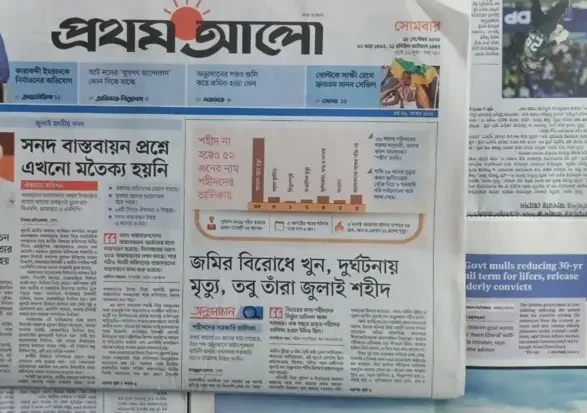
Summary
An in-depth investigation by Prothom Alo has uncovered significant discrepancies in the official list of individuals recognized as “martyrs” of Bangladesh’s July 2024 mass uprising.
The report identifies at least 52 names on the government’s list of 834 who do not meet the official criteria for martyrdom. These include victims of personal land disputes, accidental electrocutions, road accidents, and individuals who died in arson attacks on properties of the then-ruling Awami League party after the government’s fall on August 5, 2024.
Family members of some listed individuals admitted to Prothom Alo that their relatives were not involved in the protests and that they were motivated by the promise of significant government compensation (~$25,700 USD one-time + monthly stipends).
The Ministry of Liberation War Affairs has initiated a nationwide verification process in response to the findings.
Context
The official martyr list was compiled by the post-uprising caretaker government led by Professor Muhammad Yunus to honor and provide for the families of those killed by state forces or pro-government actors during the pro-democracy protests that ousted the Awami League government.
- Bdnews24 and The Daily Star have also noted that several deaths post-August 5, 2024, including in land disputes or accidents, were wrongly included.
- The Ministry of Liberation War Affairs is undertaking re-verification after sending directives to all district commissioners (DCs).
- Historical context: The July 2024 student-led anti-inequality uprising led to the fall of the Sheikh Hasina government and the formation of an interim government under Prof. Muhammad Yunus. Official martyrs’ lists were part of the transitional justice and recognition measures.
- Government compensation includes 30 lakh BDT (~USD 25,700) per family and ongoing monthly stipends of 20,000 BDT (~USD 170), alongside housing projects for beneficiaries.
Editorial Intelligence Report
- Editorial Angle
- Source Credibility
- Ideological Leaning
- Sentiment
- Balance of Reporting
- Primary Sources Used
- Tone & Language
- Headline Accuracy
- International Relevance
- Watch Points (Bias/Risk)
| Investigative. The piece is a classic example of accountability journalism, seeking to verify official claims against documented evidence and firsthand accounts. |
| High. Prothom Alo is Bangladesh’s most widely circulated and respected Bengali-language daily, known for its investigative journalism. The report is based on two months of fieldwork, interviews with 41 families, and analysis of police case documents and hospital records. |
Neutral / Liberal. The report focuses on factual discrepancies and procedural failures without advocating for any political faction. Its leaning is towards transparency and good governance.
Negative / Concerned. The tone is one of concern over the integrity of a state-sanctioned process meant to honor national heroes, highlighting corruption and administrative failure.
Balanced. The report extensively quotes family members, police records, hospital sources, and government officials (including the Joint Secretary of the relevant ministry and the CEO of the Martyr Foundation), providing multiple perspectives.
Eyewitnesses (family members), Govt Officials (Ministry, District Administrators, Police), Experts (lawyer), and official Documents (case files, hospital records, government gazettes).
Formal and Fact-Based. The language is measured and relies on presenting verified evidence. It avoids sensationalism, letting the findings speak for themselves.
Reflects content. The original Bengali headline (“Land dispute murder, accident death, yet they are July martyrs”) accurately captures the core revelation of the investigation.
Medium. This speaks to issues of post-conflict reconciliation, state capacity, administrative integrity, and the challenges of managing transitional justice and compensation schemes, which are relevant to diplomats and NGOs working in governance and human rights.
- Risk of family-driven exaggeration and distressing genuine martyr families
- Verify all compensation claims;
- Political sensitivities around martyr designation;
- Can be weaponized by political opponents of the current caretaker government to question its legitimacy and competence.
Business Implications
- Governance & Policy Risk: This exposes significant weaknesses in the interim government’s administrative vetting processes. For investors and diplomats, it raises questions about the government’s capacity to execute complex, high-stakes programs fairly and accurately, potentially affecting confidence in other policy initiatives.
- Political Stability & Social Cohesion: The credibility of the martyr narrative is a cornerstone of the political legitimacy of the post-July 2024 order. This erosion of trust could fuel public cynicism and become a rallying point for critics, potentially destabilizing the fragile political consensus ahead of elections.
- Fiscal Reputational Risk: The misuse of public funds (compensation of ~$1.3 million USD already disbursed to ineligible families, per the report) is a reputational issue for the government and could lead to donor scrutiny regarding financial governance and accountability mechanisms.
- Legal & Judicial Risk: The report mentions “reverse cases” where families of ineligible “martyrs” have filed cases against protesters, leading to arrests. This indicates the judicial system is being exploited based on a flawed state document, creating legal insecurity and potential for human rights grievances.
Potential Angles to Monitor
- The Verification Process: Track the progress and findings of the Ministry’s district-level verification. How many names are ultimately removed? What political pressures are DCs facing?
- The Compensation Clawback: Investigate the legal and practical challenges of recovering funds already disbursed to ineligible families, as the Martyr Foundation has attempted with three individuals.
- Profile the Arbiters: Deep dive into the July Martyr Smriti Foundation—who is on its board, how decisions are made, and what internal debates led to the initial questionable inclusions.
- International Precedent: A comparative analysis on how other nations (e.g., Tunisia, Chile) have managed martyr compensation and verification after political upheavals, offering lessons for Bangladesh.
- The Genuine Martyrs’ Families: A follow-up story focusing exclusively on the families of verified martyrs and their reaction to this scandal, their economic situation, and their quest for justice.
Frequently Asked Questions
Related Headlines
Prothom Alo – Murder over land dispute, death in accident, yet they are in July Martyrs list
Dhaka Tribune – Gazette: July martyrs’ families to receive 30L, monthly allowances
DW Bangla – What is the actual number of July martyrs?
BSS – Legal action to be taken against fake July fighters: Liberation War Ministry