

A fresh wave of violence has once again placed Bangladesh’s religious minorities in a climate of fear. Since the fall of Sheikh Hasina’s 15-year iron-fisted rule in August 2024, Bangladesh has entered a fragile period of political transition.
Nobel Laureate Muhammad Yunus now heads an interim government tasked with stabilizing the nation and preparing it for elections. Yet amid promises of reform, a wave of attacks has unsettled religious minorities: Sufi shrines defiled, Hindu temples vandalized, and Ahmadiyya communities threatened.
For many, the uprising that once held hope for democratic renewal now carries a chilling question — whether hardline Islamist groups are finding new space to assert influence, leaving vulnerable communities exposed to escalating violence.
A Surge in Attacks on Shrines and Temples
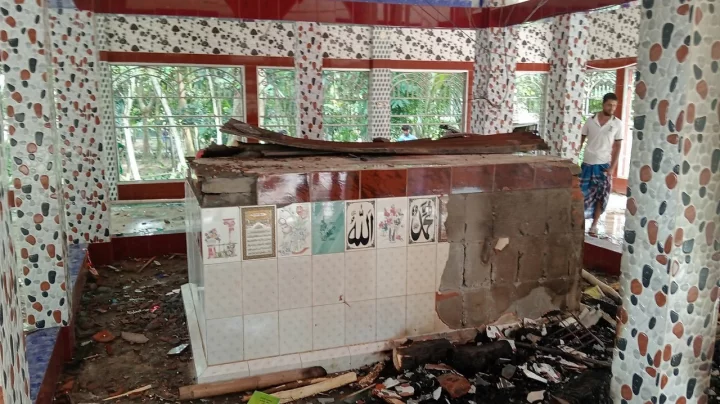
In early September, the body of Sufi cleric Nurul Haque, popularly known as Nural Pagla, was exhumed and burned in broad daylight in Rajbari district. Video footage of the desecration spread quickly on social media, sparking outrage across the country. Even the interim government led by Nobel laureate Muhammad Yunus condemned the incident.
Yet condemnation has not stemmed the violence. Within weeks, at least four more shrines in Cumilla and one in Mymensingh were vandalized and set ablaze.
Community leaders note that these attacks are often preceded by loudspeaker announcements from local mosques, where clerics denounce Sufi practices as “un-Islamic.”
Sufi traditions in Bangladesh combine centuries-old mysticism with local cultural expression, with shrines (mazars and dargahs) serving as worship sites, community hubs, and spaces for music and festivals.
The attacks extend beyond spiritual harm, disrupting cultural practices and the livelihoods of thousands of mystic singers, with the Bangladesh Baul and Folk Artists Association reporting that more than 300 performances were cancelled in the past year due to Islamist pressure.
Hindu Communities Under Pressure
Parallel intimidation has affected the Hindu population, which makes up roughly 8–10 percent of Bangladesh. As preparations began for Durga Puja, the largest Bengali Hindu festival, temples in Kushtia, Gazipur, Netrokona, and Jamalpur reported vandalism of idols. Minority activists say such incidents intensify around major festivals, magnifying insecurity during what should be celebratory moments.
Adding to the unease, Home Affairs Advisor Jahangir Alam sparked outrage by suggesting that alcohol and marijuana are integral to puja fairs — a claim long circulated by hardliners. Jahangir, said, “Fair stalls won’t be allowed around the puja mandaps this year in any way because alcohol and marijuana gatherings are held at those fairs.” Various groups made calls for an apology, terming it not only hurt religious sentiments but also raised questions about communal harmony.
Other incidents have fueled fear across the country. In late July, panic spread in Gangachara, Rangpur, after a teenage boy was arrested for allegedly making derogatory remarks about the Prophet; soon after, his home and at least 14 Hindu houses were vandalized.
Around the same period, in Sitakunda of Chittagong, Islamists sought to build a mosque at the Chandranath Hill temple, a major Hindu pilgrimage site, where young men had earlier been seen chanting Islamic slogans.
Other districts have witnessed similar tensions. In Lalmonirhat, a simple dispute at a barbershop escalated when a mob accused a Hindu barber and his son of blasphemy, assaulting them before police eventually arrested the victims themselves. In Netrokona, attacks on low-caste Hindu families in June left homes demolished, reportedly to seize land for an Islamic school.
Rights monitors and local media report several dozen such incidents in recent months, suggesting a pattern rather than isolated events.
Ahmadis Face Renewed Threats
Bangladesh’s small Ahmadiyya Muslim community has long been marginalized, but pressure has intensified since the transition. The group International Majlis Tahaffuz Khatme Nabuwat Bangladesh has called for a November 15 rally in Dhaka, demanding the state officially declare Ahmadis “non-Muslims.”
The demand mirrors Pakistan’s 1974 constitutional amendment that disenfranchised Ahmadis. Rights groups warn that if such rhetoric gains momentum in Bangladesh, it could normalize persecution, particularly as election season approaches and Islamist factions seek to influence party manifestos.
Political Transition Fuels Religious Intolerance?
Attacks on minorities—including Sufis, Hindus, and Ahmadis—reflect a complex interplay of political unrest and religious intolerance.
The resurgence of Islamist groups has coincided with Bangladesh’s political transition under the Yunus administration. Jamaat-e-Islami, banned from elections under Hasina, has resurfaced alongside smaller hardline outfits. These groups have demanded that music and dance teachers be replaced with religious instructors in every primary school.
Rights advocates warn that this could reshape Bangladesh’s secular education system and entrench conservative religious influence.
For minority communities, the stakes are existential. Bangladesh’s constitution enshrined secularism as a founding principle after independence in 1971, when groups like Jamaat sided with Pakistan against liberation forces. Today, minorities warn that any erosion of secular guarantees would mark a dangerous reversal.
Meanwhile, the interim government has repeatedly pledged “zero tolerance” for communal violence, citing police reports, legal filings, and community policing, yet authorities classify most incidents—out of 1,415 reported attacks since August—as politically rather than communally motivated.
Minority leaders and rights groups dispute this framing, arguing that it minimizes religious motives, particularly in cases triggered by blasphemy accusations or ritual practices. They warn that treating incidents as primarily political risks overlooking religious intolerance and failing to protect vulnerable communities.
According to minority rights activists, historical exclusion of minorities from policymaking and the growing influence of hardline groups have heightened fears of impunity.
Arrests are rare, and few cases progress to formal charges, reinforcing the perception that attacks on minorities are tolerated. Community leaders warn that without visible accountability, hardliners may continue to exploit political instability to escalate threats.
A Crossroads for Bangladesh
Bangladesh stands at a critical juncture. The fall of Hasina’s authoritarian regime opened possibilities for democratic renewal, institutional reform, and greater inclusivity. Yet the months since have also exposed how fragile the country’s pluralist fabric has become.
For Sufis, Hindus, and Ahmadis, each desecrated shrine or temple is more than vandalism — it is an assault on identity, heritage, and belonging. For the interim government, credibility depends not only on condemnation but on whether protection is visible, justice is delivered, and secularism is upheld in practice.
As the South Asian nation moves toward its next election, how it treats its minorities will test the resilience of its democracy: will safety, dignity, and equal rights be guaranteed for all citizens, or will a culture of impunity and emboldened hardliners shape the political future?