

Summary
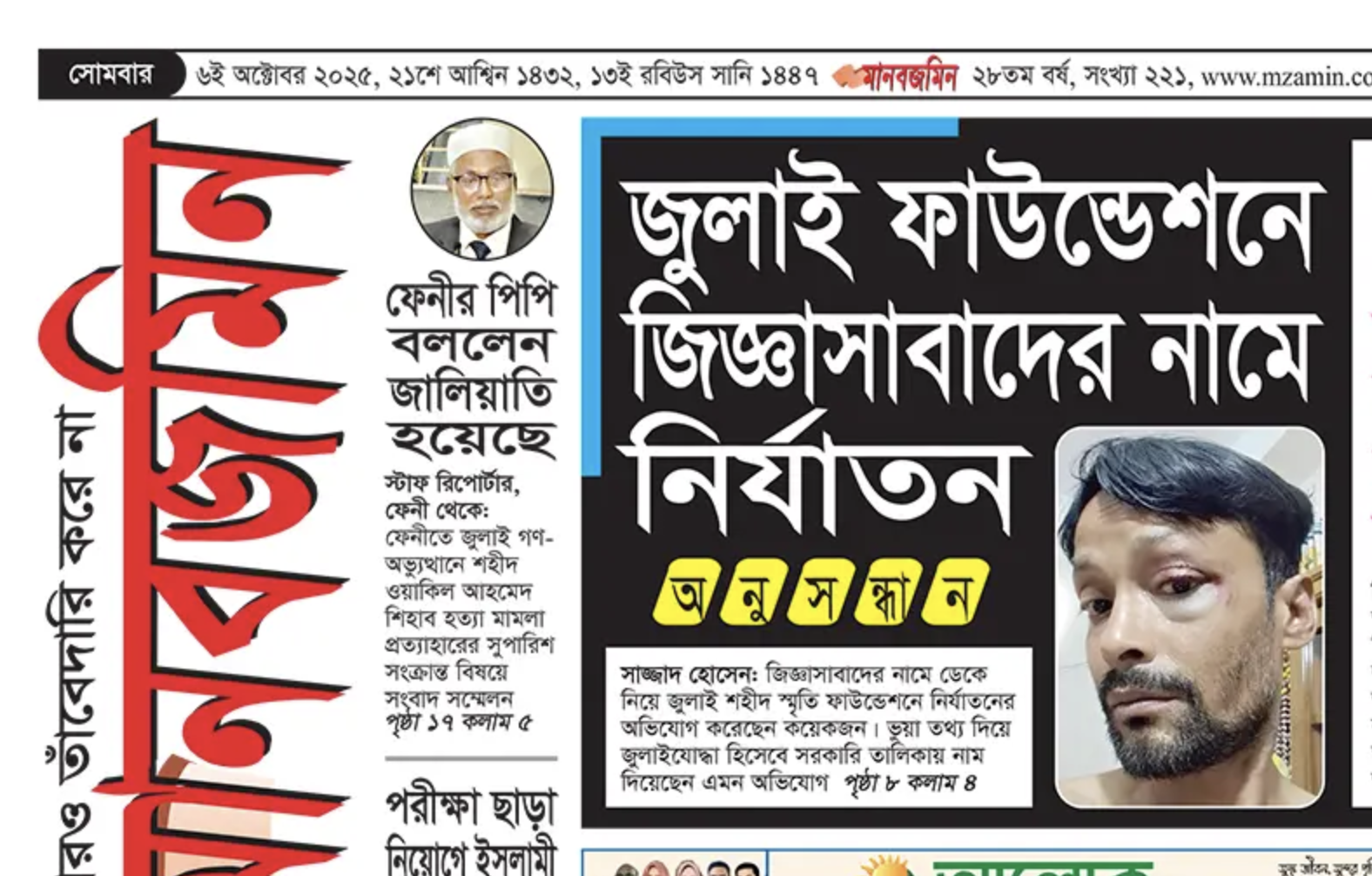
The July Martyrs’ Smriti Foundation faces severe allegations of torturing individuals during its verification process for beneficiaries.
Victims, including an injured protester and a businessman, claim they were lured to the foundation’s office, held in back rooms, and beaten to extract false confessions of being “fake injured”, reports Bangla daily Manab Zamin.
The foundation’s CEO has denied prior knowledge and pledged to refer future cases to police, while a verification officer expressed regret for any “rudeness.” The claims challenge the foundation’s core mission, established to support victims of a pro-democracy movement.
Context
The July Martyrs’ Smriti Foundation was established by the Bangladeshi government to disburse financial aid and honor individuals affected by the July 2024 student-led anti-discrimination movement, which saw violent clashes.
The process of verifying thousands of claimants has been contentious, with authorities frequently alleging widespread fraud by “fake injured” and “fake martyrs.” The recent allegations, reported by leading Bengali dailies, suggest that this verification process may have involved extreme, unauthorized methods. This creates a profound irony, as the foundation was born from a movement that itself protested state violence and secret detentions.
The scandal threatens to undermine public trust in the institution and raises questions about oversight and accountability in state-led welfare mechanisms.
Editorial Intelligence Report
- Editorial Angle
- Source Credibility
- Ideological Leaning
- Sentiment
- Balance of Reporting
- Primary Sources Used
- Tone & Language
- Headline Accuracy
- International Relevance
- Watch Points (Bias/Risk)
Investigative / Activist-leaning – The report prioritizes the detailed, emotional narratives of the alleged victims to expose potential institutional abuse.
Mixed: Medium to High – Main allegations come from Manab Zamin (detailed victim accounts) while mainstream outlets (Prothom Alo, New Age) verify fund figures and protests; the foundation’s own statements are public. Cross-checking between these sources increases credibility, but reliance on a local tabloid for first allegations requires corroboration.
Neutral/Non-partisan in reporting tone – Most coverage focuses on facts and responses rather than party politics, though the topic is politically sensitive because the foundation links to interim government initiatives.
Negative / Alarmist – The tone is heavily weighted towards the victims’ trauma, portraying the foundation’s actions as a betrayal of its founding principles.
One-sided – The report gives extensive space to victim accounts and includes foundation responses, but these responses are framed as defensive and are heavily challenged by the victims’ detailed narratives.
Victim eyewitnesses; foundation spokespeople/CEO; mainstream press briefings; MIS/gazette lists and government communication.
Sensational / Emotional – Uses evocative language (“beaten,” “torture,” “mental breakdown”) to emphasize the severity of the allegations.
Reflects content – The analysis accurately centers on the torture allegations and their damaging impact on the foundation’s reputation.
High – Highlights issues of state-backed bodies, human rights, and accountability in a politically significant South Asian nation, relevant for human rights monitors and regional analysts.
- High risk of emotional framing;
- Risk of over-reliance on unverified eyewitness testimony, need medical/forensic records
- The foundation’s rebuttals may be insufficiently explored.
- Political stakes are high: misreporting could be politicised by opponents or authorities.
Business Implications
- Donor & Fiscal Confidence: The foundation handled large funds (reported ~Tk96.67 crore redistributed). Allegations of abuse and opaque verification risk eroding public and donor trust—domestic donors, diaspora funders, and multilateral partners may demand stronger transparency, audits, and conditional disbursement mechanisms. (Tk96.67cr ≈ US$7.94m using Bangladesh Bank reference FX ~121.78 BDT/USD).
- Governance & Oversight: This episode highlights weakly enforced oversight in emergency-style payouts. Governments and independent auditors should create clear SOPs for beneficiary verification, third-party grievance mechanisms, and CCTV/forensic audit trails for contested cases. Such protocols protect both victims and administrators.
- Political Risk & Legitimacy: The foundation is associated with the interim government’s handling of July victims; mishandling claims can deepen political polarization and fuel protests — a reputational and operational risk for entities tied to transitional authorities.
- Legal & Compliance Exposure: If allegations of physical abuse are substantiated, civil or criminal liabilities could follow for individuals and managers. NGOs and vendors working with the foundation must reassess compliance, background checks, and staff training on human rights standards.
- Social Stability & Service Delivery: Delayed payments and perceived favoritism among beneficiaries can spark local unrest (seen in office vandalism). Rapid, transparent grievance redress reduces the chance of protests escalating into wider public disorder.
- Opportunity for Reform: International partners and local civil society can offer conditional technical assistance (digital MIS verification, independent grievance panels, forensic medicine support, and public transparency dashboards). Such assistance could restore confidence and reduce friction in future disbursements.
Potential Angles to Monitor
- On-the-record interview with foundation CEO Lt. Col. (Ret.) Kamal Akbar — ask for CCTV logs, internal complaints register, and results of any internal probes.
- Victims & family members (e.g., Jahangir, Bulbul’s family) — obtain detailed timelines, medical records, and witnesses.
- Verification officer (Saidur Rahman Shahid) — question about verification SOPs, CCTV claims, and chain of custody for records.
- Ministry/ DGHS / Civil Surgeon office — clarify MIS/gazette process and how lists are certified.
- Independent forensic doctor — review alleged injuries and advise what medical proof would confirm or refute claims.
- Local human rights NGOs (Amnesty, Odhikar, Ain o Salish Kendra) — ask about complaint handling, patterns of abuse, and recommendations for independent oversight.
Frequently Asked Questions
Additional Reading
Manab Zamin – Torture in the name of interrogation at the July Foundation
New Age – Jatiya Nagorik Committee leader sent to jail over July foundation fund fraud
The Business Standard – July uprising injured vandalise foundation office over due compensation
Prothom Alo – Fraudulence to get July Foundation donation
BD News – How far can July Foundation go amid a deepening funding crisis?
New Age – Many victims yet to get any help