This Content Is Only For Subscribers
The recent landslide victories of Islami Chhatra Shibir in key student union elections have significantly boosted its mother organization, Jamaat-e-Islami, putting the Bangladesh’s largest Islamist party in a commanding position ahead of the next general elections. The momentum has allowed Jamaat to launch a coordinated program of political demands, while the Bangladesh Nationalist Party (BNP), long seen as the main challenger to the Awami League, appears weakened and fragmented.
BNP initially seemed confident about exerting influence in the decision-making process of the interim government under Chief Advisor Muhammad Yunus soon after the fall of Awami League on August 5, 2024. But allegations of extortion, indiscipline among grassroots leaders, and internal rifts have left the party in disarray. Jamaat’s current strategy appears to be capitalizing on BNP’s weaknesses, adding fresh woes to the beleaguered party.
In Pursuit of an Islamic Bloc to Counter BNP?
Jamaat, alongside several like-minded Islamist parties, has launched simultaneous programs pressing four key demands: legalizing and implementing the July Charter, holding national elections under a proportional representation (PR) system, ensuring a level playing field, and banning the Jatiya Party and allied 14-party groups as “accomplices of fascism.”
Meanwhile, other Islamist parties have also stepped up their activities. Islami Andolan Bangladesh, led by Syed Rezaul Karim, widely known as the Charmonai Pir, and the Bangladesh Khelafat Majlis, headed by Maulana Mamunul Haque, have both announced parallel programs pressing nearly identical demands.
Since September last year, visible efforts have been underway to forge a broader alliance of Islamist parties, signaling a calculated attempt to consolidate their strength. The push for unity reflects both ideological alignment and a tactical move to counterbalance the BNP, and to present themselves as a credible alternative to BNP in mobilizing opposition forces.
READ MORE:
- Is Jamaat-e-Islami Shifting? ‘1971 Apology’ Debate After Memorial Visit by Student Wing
- Bangladesh Islamist Bloc to Launch Coordinated Push for July Charter and PR Elections
- Islamist Student Wing Ends Decades of Exclusion, Redraws Dhaka University’s Political Map
For BNP, this trend poses a dual threat: it risks losing conservative voters to more organized Islamist platforms, while also facing competition in setting the opposition agenda. For the Awami League’s opponents more broadly, a unified Islamist bloc could emerge as a decisive player in shaping post-Hasina politics, whether through street programs, bargaining power in negotiations, or influence over electoral outcomes.
Key Demands Explained
The July Charter is the political document aiming to translate the 2024 mass uprising demands into constitutional and institutional reforms. The National Consensus Commission, tasked with political dialogue, has clarified its limited role in this process. On September 11, its vice-president Professor Ali Riaz said the commission cannot enforce the July Charter, only facilitate discussions and convey outcomes to the government.
So, what would be a possible way out of this demand is negotiated assurances that whichever party comes to power is obliged to implement the charter, and other parties, including the NCP, can work as a pressure group.
The PR system, which allocates seats based on party vote share, remains contentious. BNP has warned it could be manipulated to delay voter choice, while supporters argue it would deliver fairer representation. However, implementation would require significant electoral and constitutional redesign. If the pressure mounts, all parties, including BNP, may reach a command ground: introducing PR in a restructured upper house rather than overhauling the entire system.
Jamaat’s demand to ban the Jatiya Party underscores a strategic calculation. Though MPs and ministers of the Awami League remain either in jail or exile, or hiding, there are Awami League supporters still existing across the country. If the party is not allowed to contest the next general elections, where these votes, say for example, a minimum of 20 per cent of total voters, will go, is the critical question.
And, the possible headache for Jamaat is that many of these floating votes can find the Jatiya Party as the better option than any other party, which would strengthen it as a parliamentary opposition. So, clearing them from the ballot could redirect those votes toward Jamaat and its allies. But already split, Jatiya Party’s fate is still undecided and depends on the negotiation and legal process.
Again, local reports have suggested that Jamaat leaders even assisted some Awami League figures in securing release from jail to grab the vote bank of Awami League supporters.
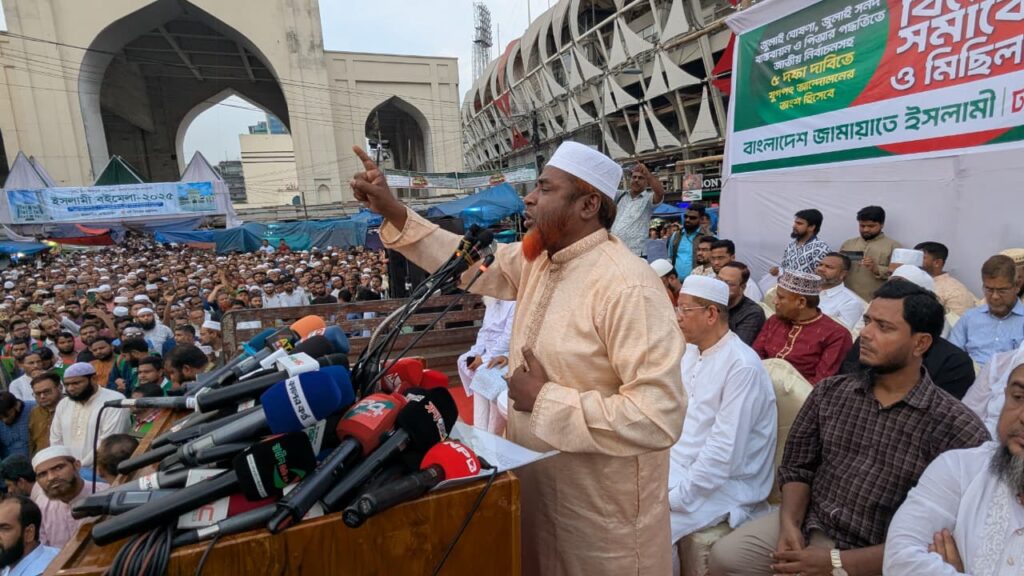
Jamaat Rebranding Itself through Liberation War & Minority Narrative
Both the Awami League and BNP have long claimed ownership of the 1971 Liberation War legacy. In the Awami League’s absence from the current political stage, BNP has sought to position itself as the chief custodian of the Liberation War spirit. But now, Jamaat-e-Islami, historically condemned for opposing independence, is making calculated moves to challenge that narrative.
For the first time since independence, Jamaat-backed student leaders visited Dhaka’s Rayerbazar killing ground memorial to pay tribute to the martyrs of 1971. The unprecedented gesture signals a possible reorientation in Jamaat’s stance on the Liberation War, a subject on which it has faced decades of stigma.
Senior Jamaat leaders are reportedly debating whether to formally acknowledge past mistakes and even issue an apology for the party’s anti-liberation role. These discussions follow earlier reformist overtures, including Barrister Abdur Razzaq’s resignation in 2019 over Jamaat’s unwillingness to confront its history, and Muhammad Kamaruzzaman’s prison writings reflecting on the issue.
“Aren’t we biased towards the Liberation War, too? When we talk about the democratic sphere, when we talk about the spirit of the Liberation War, human equity and dignity, when we talk about democracy, free-fair environment, rule of law, and transparency and accountability – is this not our biasness?,” argued Shishir Manir, a senior Jamaat lawyer, during a recent television talk show.
He further added, “ We have never in our lives been involved in embezzlement. Is this not the sentiment of 71? Doesn’t it cover social and human equity and dignity? Not Transparency and accountability? Democracy? free-fair environment? Liberty to live, and right to liberty? We’re advocating for these. Then, is only uttering the sentiment by mouth enough or by proving by works?”
To reinforce this rebranding, Jamaat has highlighted minority participation, including Hindu and Chakma members, and has hinted at showcasing women’s leadership within the party in the coming months—an effort to counter its decades-old image of opposing women’s rights. In its latest unusual move, at least 25 people, identifying as Hindus, joined the Islamist party in northern district, Chapainawabganj.
Some of the most contentious demands—such as appointing religious instructors in place of music teachers at primary schools and repeated calls to dictate how women should dress—remain deeply divisive. Attacks on women’s football matches, intimidation of members of the women’s reform commission, and recurring incidents of violence against women have further fueled public outrage.
Critics argue that the interim government has so far failed to respond decisively to these challenges, allowing extremist narratives to gain ground, a claim outrightly denied by the government.
The recent exhumation and burning of a Sufi pir’s body in Rajbari by hardline Islamists sparked widespread outrage on social media. Minority Muslim groups, including Sunni sub-sects and the Ahmadiyya community, report that more than a hundred shrines have been attacked over the past year. Jamaat-e-Islami and allied Islamist parties have frequently been accused of orchestrating or inciting these campaigns—allegations they have consistently denied.
BNP Internal Crisis Strengthens Jamaat Strategy
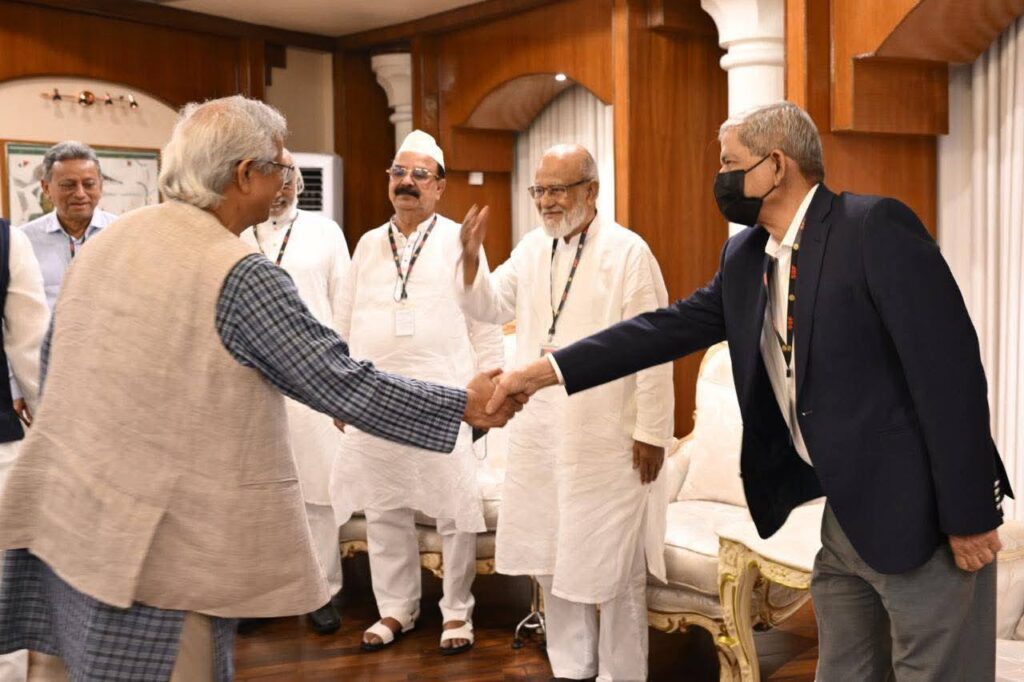
Meanwhile, BNP remains in turmoil. The prolonged absence of its acting chairman, Tarique Rahman, who has been in exile in London for 17 years, has fueled uncertainty within the party. His indefinite return date has left grassroots activists frustrated, with many accused of resorting to extortion and infighting to assert local supremacy. At the top, the apparent rifts between senior and younger leaders have further undermined BNP’s ability to function as a cohesive, well-organized political force.
Jamaat has been quick to take this vacuum. By regrouping with like-minded Islamist parties and expanding its reach across campuses and grassroots networks, where religious motivations often resonate, it has consolidated an influence that BNP admits it has failed to build.
“The vice-chancellors of various universities are Jamaat members. Those who are becoming judges of various courts and high courts are Jamaat members. And what are we doing? We are occupying launch ghats, bus stands, ferry ghats,” lamented former Home Minister and BNP Vice Chairman Altaf Hossain Chowdhury in a recent speech.
Soon after the ouster of the iron-fisted regime of former Prime Minister Sheikh Hasina through the popular mass uprising on August 5, 2024, BNP initially appeared poised to lead the post-Awami League political order.
Although the newly-formed National Citizen Party (NCP) initially sought to position itself as a major political force under the interim government led by Nobel laureate Professor Muhammad Yunus, its performance has so far fallen short of expectations. The party has struggled to secure broad-based public support and has instead become embroiled in controversies over weak leadership, allegations of extortion, and organizational irregularities—issues that have further eroded its credibility at a critical political juncture.
But with time, Jamaat, which remained ‘politically hideout’ for over 15 years, has repositioned itself as a more disciplined, strategically agile force. Through campus victories, grassroots mobilization, and ideological rebranding, Jamaat is steadily turning the tables, keeping BNP at bay and pushing itself to the center of Bangladesh’s evolving political negotiations.